Description
Take your OCT to the next level
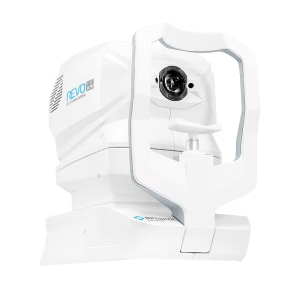
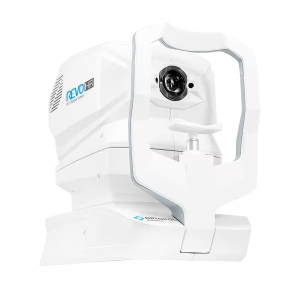
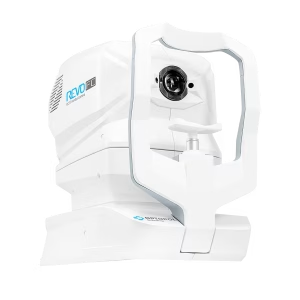
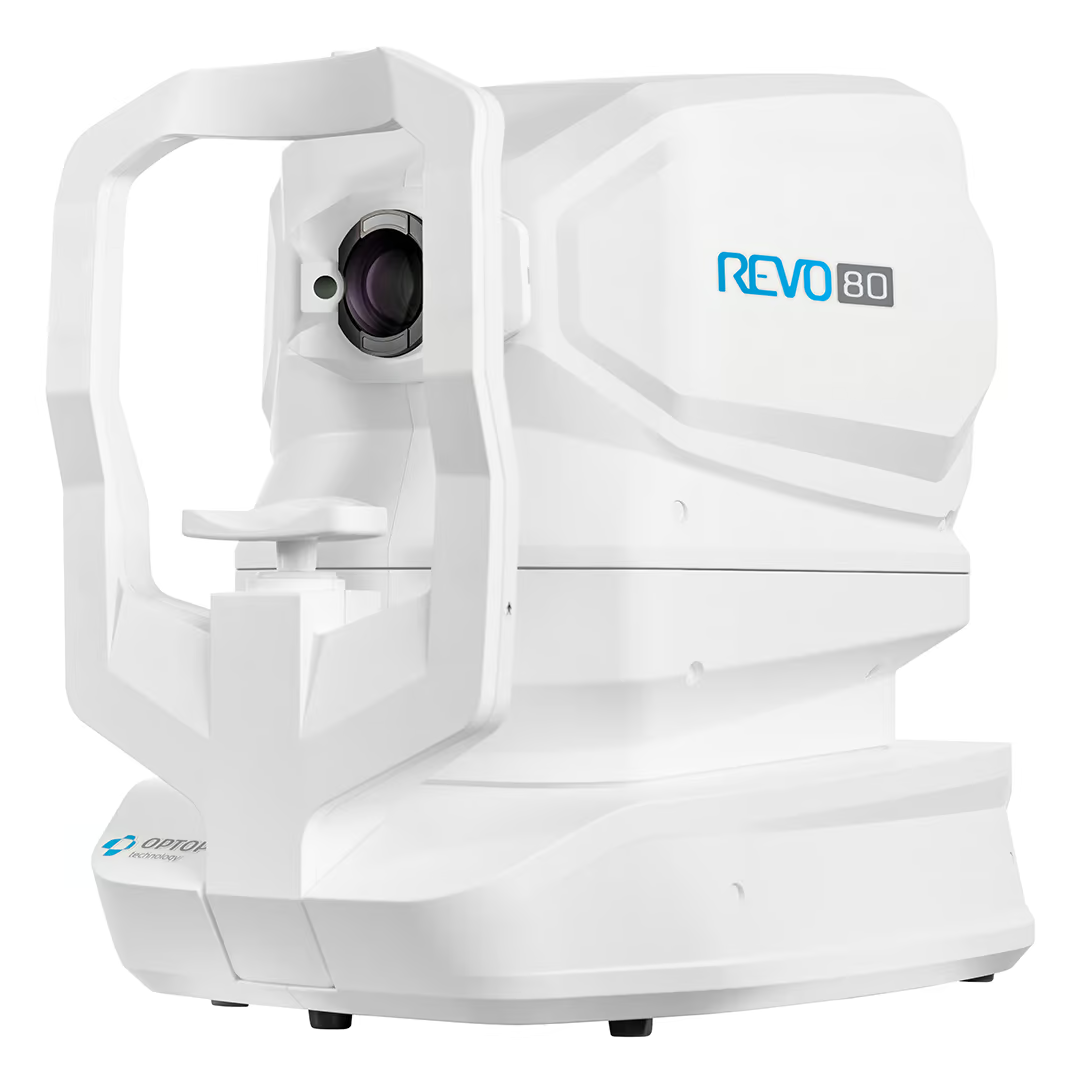
REVO 80

Full range
With scans presenting New Extended Depth™ software, based on our Full Range technology, this new imaging mode provides scans of increased depth for reliable and convenient observation of challenging cases. The Full Range mode is perfect for diagnosing even highly myopic patients.

Structure&Function (S+F)
Comprehensive glaucoma solution that combines REVO OCT and PTS Visual Field results. S+F takes the diagnostic approach of the Hood report.Our S+F report allows clinicians to understand the relationship between structural glaucoma damage and the functional impact on the patient’s field of vision. This provides a quick and comprehensive single-page report for glaucoma management.
Custom Scan Protocols
Save time and never miss a scan. Combine any scan type into a pre-set group. Choose a group of scans and set the order, the REVO will do the rest.

Glaucoma Tool Kit
Comprehensive glaucoma analytical tools for quantification of the Nerve Fiber Layer and Ganglion Cell Layer. The Disc Damage Likelihood Scale enables clinicians to precisely diagnose and monitor glaucoma for Optic Nerve Head analysis.

AI DeNoise
An advanced artificial intelligence (AI) algorithm removes noise from the tomogram for the highest image quality.

Progression Analysis
Quickly view a chronological set of exams for analysis of changes in morphology, quantified progression maps, and progression trends.
Technical Specifications
| Technology | Spectral Domain OCT |
| Scanning speed | 80 000 A-scans per second |
| Light source | SLED Wavelength 850 nm |
| Bandwidth | 50 nm half bandwidth |
| Axial resolution | 2.8 μm digital, 5 μm in tissue |
| Transverse resolution | 12 μm, typical 18 μm |
| Overall scan depth | 2.8 mm / ~6 mm in Full Range mode |
| Scan range | Posterior 5–15 mm, Angio 3–6 mm, Anterior 3–18 mm |
| Scan program | 3D, Angio¹, Full Range Radial, Full Range B-scan, Radial, B-scan, Raster, Cross, TOPO¹, Biometry AL¹ |
| Fundus image | Live Fundus Reconstruction |
| Alignment method | Fully automatic, Automatic, Manual |
| Retina analysis | Retina thickness, Inner Retinal thickness, Outer Retinal thickness, RNFL+GCL+IPL thickness, GCL+IPL thickness, RNFL thickness, RPE deformation, MZ/EZ-RPE thickness |
| Angiography OCT¹ | Vitreous, Retina, Choroid, Superficial Plexus, RPCP, Deep Plexus, Outer Retina, Choriocapilaries, Depth Coded, SVC, DVC, ICP, DCP, Custom, Enface, FAZ, VFA, NFA, Quantification: Vessel Area Density, Skeleton Area Density, Thickness map |
| Angiography mosaic | Acquisition method: Auto, Manual Mosaic modes: 10 mm x 6 mm, Manual up to 12 images |
| Glaucoma analysis | RNFL, ONH morphology, DDLS, OU and Hemisphere asymmetry, Ganglion analysis as RNFL+GCL+IPL and GCL+IPL, Structure + Function² |
| Anterior | Pachymetry, Epithelium map, Stroma map, AIOP, Angle Assessment, AOD 500/750, TISA 500/750 |
| Anterior (no lens/adapter required) | Anterior Chamber Radial, Anterior Chamber B-scan, Angle to Angle view |
| Biometry OCT¹ | AL, CCT, ACD, LT, P, WTW |
| IOL Calculator³ | Hoffer Q, Holladay I, Haigis, Theoretical T, Regression II |
| Corneal Topography Map¹ | Axial [Anterior, Posterior], Refractive Power [Kerato, Anterior, Posterior, Total], Net Map, Axial True Net, Equivalent Keratometer, Elevation [Anterior, Posterior], Height, KPI (Keratoconus Prediction Index) |
| Connectivity | DICOM Storage SCU, DICOM MWL SCU, CMDL, Networking |
| Min. pupil size | 1.7 mm |
| Focus adjustment range | -25D to +25D |
| Dimensions (L×W×H) / Weight | 479 × 367 × 493 mm / 29 kg |
| Fixation target | OLED display (adjustable shape and position), External fixation arm |
| Power supply / Consumption | 100–240 V, 50/60 Hz / 90–110 VA |
| ¹ Optional software module ² Via connection with PTS software version 3.4 or higher ³ Biometry module and separate IOL Calculator license required | |